
Direct Admission in MBBS Through Management Quota: Eligibility, Fees, Process & College Options in India
Direct Admission in MBBS Through Management Quota: Eligibility, Fees, Process & College Options in India
Securing a seat in an MBBS program is one of the most competitive academic pursuits in India. With millions of aspirants competing for limited government medical seats through NEET, many qualified students explore alternative pathways to fulfill their dream of becoming doctors.
Direct Admission in MBBS through the management quota has emerged as a viable option for students who have the required qualifications but may not have secured top NEET ranks.
This admission route, available in private medical colleges across India, provides opportunities for deserving candidates to pursue medical education through a transparent and legitimate process.
Understanding the eligibility criteria, fee structure, admission process, and available college options is essential for making an informed decision about this pathway.
What is Management Quota in MBBS Admissions?
This admission route is completely legal and regulated by the Medical Council of India (now National Medical Commission) and respective state government authorities.
The primary difference lies in the fee structure and the admission process, which is handled directly by the college management rather than through centralized counseling.
Eligibility Criteria for Management Quota Admissions
Academic Qualifications
To be eligible for Direct Admission in MBBS Through Management Quota, candidates must meet the following requirements:
Basic Educational Requirements:
- Completion of 10+2 or equivalent examination from a recognized board
- Physics, Chemistry, and Biology as mandatory subjects in 12th standard
- Minimum 50% aggregate marks in PCB for general category students
- Minimum 40% aggregate marks in PCB for reserved category students (SC/ST/OBC)
- English as a compulsory subject
NEET Qualification
NEET UG Examination:
- Valid NEET UG scorecard is mandatory for all MBBS admissions in India
- Candidates must have appeared and qualified in NEET UG in the current or previous year
- General category: 50th percentile for
- General-PwD category: 40th percentile for
- SC/ST/OBC categories: 40th percentile for
Age Criteria
| Category | Minimum Age | Maximum Age |
| General & OBC | 17 years (as of Dec 31st of admission year) | No upper limit |
| SC/ST/PwD | 17 years (as of Dec 31st of admission year) | No upper limit |
Additional Requirements
- Indian citizenship or NRI/OCI status
- Medical fitness certificate
- Character certificate from previous institution
- Transfer certificate and migration certificate
- Domicile certificate (for state quota seats, if applicable)
Fee Structure for Management Quota Seats
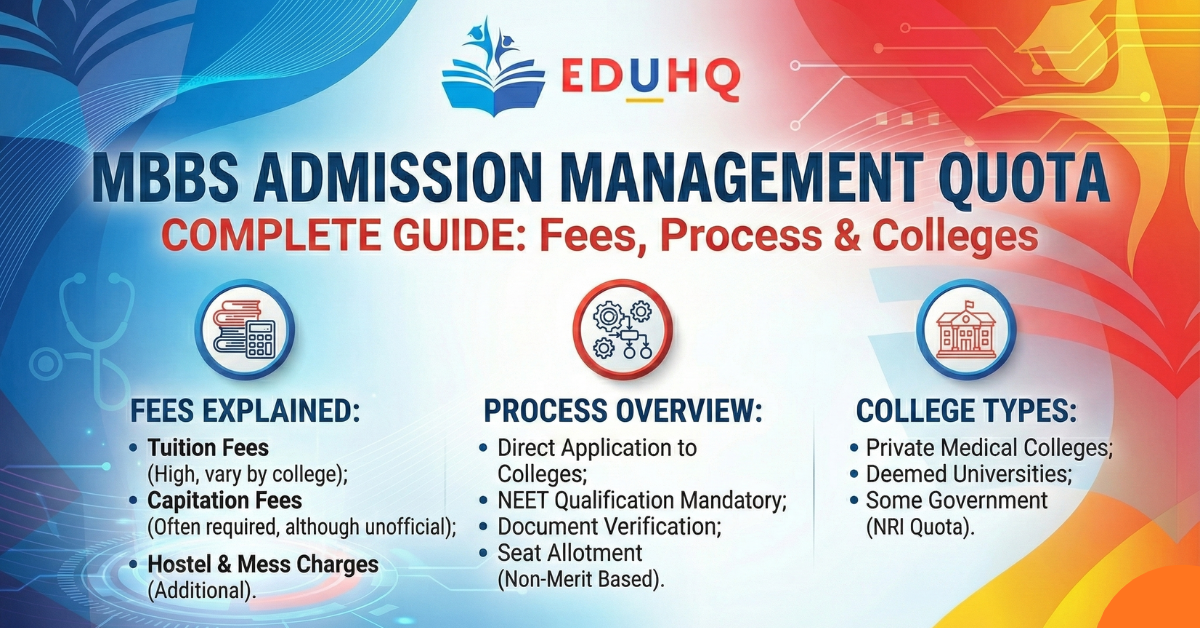
The fee structure for management quota seats varies significantly based on the college’s location, infrastructure, faculty, and reputation. Here’s a comprehensive breakdown:
Approximate Annual Fee Range
| College Type | Annual Fee Range | Total Course Fee (5.5 years) |
| Tier-1 Private Colleges (Metro Cities) | ₹15-25 lakhs | ₹82.5 lakhs – ₹1.37 crores |
| Tier-2 Private Colleges (Smaller Cities) | ₹8-15 lakhs | ₹44 lakhs – ₹82.5 lakhs |
| Deemed Universities | ₹18-30 lakhs | ₹99 lakhs – ₹1.65 crores |
| NRI Quota in Private Colleges | $40,000-$70,000 | $2.2-3.85 lakhs (full course) |
Fee Components
The total fee structure typically includes:
- Tuition Fee: The primary academic fee charged annually
- Development Fee: One-time or annual infrastructure development charges
- Hostel Fee: Accommodation charges (usually separate)
- Mess Fee: Food and dining charges
- Library Fee: Access to medical library and journals
- Laboratory Fee: For practical sessions and clinical training
- Examination Fee: Semester or annual examination charges
- Miscellaneous Charges: Sports, medical insurance, student activities
State-Wise Management Quota MBBS Fees 2026 in India
Below is the comprehensive state-wise breakdown of management quota MBBS fees for various private medical colleges across India:
| State | Institute Name | Ownership | Total annual fee (MBBS) |
| Maharashtra | Datta Meghe Institute of Higher Education and Research, Wardha | Private (Deemed) | ₹2,78,000 |
| Dr DY Patil Vidyapeeth, Pune | Private (Deemed) | ₹27,80,000 | |
| Dr. D.Y. Patil Medical College, Pimpri | Private (Deemed) | ₹27,30,000 | |
| Dr. D.Y. Patil Medical College, Lohegaon | Private (Deemed) | ₹26,50,000 | |
| Bharati Vidyapeeth Deemed University Medical College, Pune | Private (Deemed) | ₹22,20,000 | |
| Symbiosis Medical College for Women, Pune | Private (Deemed) | ₹13,33,333 | |
| Karnataka | Kasturba Medical College, Mangalore | Private (Deemed) | ₹12,89,000 |
| Kasturba Medical College, Manipal | Private (Deemed) | ₹7,99,000 | |
| JSS Medical College, Mysore | Private (Deemed) | ₹22,00,000 | |
| Uttar Pradesh | Shri Ram Murti Smarak Institute of Medical Sciences, Bareilly | Private (Deemed) | ₹19,45,000 |
| Madhya Pradesh | RD Gardi Medical College, Ujjain | Private (Deemed) | ₹11,10,000 |
| Sri Aurobindo Medical College & PG Institute, Indore | Private (Deemed) | ₹16,26,000 | |
| Rajasthan | Geetanjali Medical College & Hospital, Udaipur | Private (Deemed) | ₹26,40,000 |
| Chhattisgarh | Shri Shankracharya Institute of Medical Sciences, Bhilai | Private (Deemed) | ₹10,00,000 |
| Odisha | Siksha ‘O’ Anusandhan, Bhubaneswar | Private (Deemed) | ₹19,95,000 |
Important Note: All fees mentioned are approximate and subject to change. Candidates should verify current fee structures directly with colleges during the admission process.
Step-by-Step Admission Process

Direct Admission in MBBS Through Management Quota
Step 1: NEET Qualification and Document Preparation
Begin by ensuring you have qualified NEET UG with the minimum required percentile. Prepare all necessary documents including:
- NEET UG admit card and scorecard
- 10th and 12th mark sheets and certificates
- Transfer certificate and migration certificate
- Character certificate
- Caste certificate (if applicable)
- Domicile certificate
- Passport-size photographs
- Identity proof (Aadhar card, passport, etc.)
Step 2: Research and Shortlist Colleges
Thoroughly research private medical colleges offering management quota admissions. Consider factors such as:
- College recognition and accreditation (NMC approved)
- Infrastructure and facilities
- Faculty expertise and student-teacher ratio
- Hospital bed capacity for clinical training
- Location and accessibility
- Fee structure and payment options
- Pass percentage in NEET PG examinations
- Placement and internship opportunities
Step 3: Direct College Contact or Consultant Approach
Option A – Direct College Approach: Contact the admission office of shortlisted colleges directly through their official website, email, or phone. Request information about:
- Seat availability under management quota
- Detailed fee structure
- Admission schedule and deadlines
- Required documents
- Counseling dates
Option B – Through Educational Consultants: Authorized educational consultants can facilitate the admission process. Benefits include:
- Guidance on college selection based on budget and preference
- Documentation assistance
- Direct liaison with college management
- Updates on seat availability
- Processing of applications
Step 4: Application Submission
Submit your application to selected colleges with all required documents and credentials. Most colleges require:
- Filled application form
- Payment of application/registration fee
- Self-attested copies of all documents
- Original NEET scorecard
Step 5: Counseling
Attend the scheduled counseling .The management will:
- Verify all submitted documents
- Discuss the fee structure and payment terms
- Explain college facilities and academic curriculum
- Address any queries or concerns
- Assess candidate’s commitment and suitability
Step 6: Fee Payment and Seat Confirmation
Upon seat offer:
- Review and sign the fee agreement
- Pay the initial fee installment (typically first-year fee or a significant portion)
- Obtain official fee receipts and admission letter
- Complete any remaining formalities
Payment Options Usually Available:
- Lump sum payment (some colleges offer discounts)
- Installment-based payment (semester-wise or annual)
- Education loan assistance
- Bank transfer or demand draft
Step 7: Document Verification and Final Admission
Complete the final admission process:
- Submit original documents for verification
- Complete medical examination
- Obtain student ID card
- Register for hostel accommodation (if required)
- Attend orientation program
- Begin classes as per academic calendar
Top Private Medical Colleges Offering Management Quota
Karnataka
Colleges:
- MS Ramaiah Medical College, Bangalore
- Kempegowda Institute of Medical Sciences, Bangalore
- JSS Medical College, Mysore
- KLE Medical College, Belgaum
- SDM College of Medical Sciences, Dharwad
- Father Muller Medical College, Mangalore
- AJ Institute of Medical Sciences, Mangalore
Key Features:
- Well-established infrastructure
- Experienced faculty
- Strong clinical training programs
- Good hospital affiliations
Maharashtra
Colleges:
- DY Patil Medical College, Pune
- Dr. D.Y. Patil Medical College, Kolhapur
- Bharati Vidyapeeth Medical College, Pune
- Krishna Institute of Medical Sciences, Karad
- MGM Medical College, Navi Mumbai
- Smt. Kashibai Navale Medical College, Pune
- Rural Medical College, Loni
Key Features:
- Strategic locations in major cities
- Modern teaching facilities
- Research opportunities
- Multi-specialty hospitals
Tamil Nadu
Colleges:
- SRM Medical College, Chennai
- Saveetha Medical College, Chennai
- Chettinad Hospital and Research Institute, Chennai
- Vinayaka Mission’s Medical College, Karaikal
- Meenakshi Medical College, Kanchipuram
- ACS Medical College, Chennai
Key Features:
- Advanced medical equipment
- Focus on research and innovation
- International exposure programs
- Strong alumni network
Uttar Pradesh
Colleges:
- Santosh Medical College, Ghaziabad
- Subharti Medical College, Meerut
- Teerthanker Mahaveer Medical College, Moradabad
- Rama Medical College, Kanpur
- Shri Ram Murti Smarak Institute, Bareilly
Other States with Management Quota Opportunities
| State | Number of Private Medical Colleges |
| Rajasthan | 15+ colleges |
| Madhya Pradesh | 12+ colleges |
| Punjab | 10+ colleges |
| Haryana | 8+ colleges |
| Telangana | 10+ colleges |
| Andhra Pradesh | 12+ colleges |
| Gujarat | 10+ colleges |
| West Bengal | 8+ colleges |
Advantages of Management Quota Admission
Flexibility in College Choice
Management quota admissions offer greater flexibility in selecting colleges based on personal preferences, location, and budget. Students are not limited by cutoff ranks and can choose institutions that align with their career goals and learning environment preferences.
Faster Admission Process
The direct admission process through management quota is typically faster than centralized counseling. Once documents are verified and fees are paid, admission is confirmed within days, reducing uncertainty and waiting periods.
Quality Medical Education
Many private medical colleges offering management quota seats provide excellent infrastructure, modern facilities, and experienced faculty. These institutions often have well-equipped hospitals, advanced laboratories, and comprehensive clinical training programs that match or exceed government college standards.
Additional Opportunities
Private medical colleges frequently offer:
- International exchange programs
- Research opportunities and projects
- Exposure to latest medical technologies
- Workshops and conferences
- Better student-teacher ratios
- Modern teaching methodologies
Important Considerations and Precautions
Verify College Recognition
Always ensure that the college is recognized by the National Medical Commission (NMC) and affiliated with a recognized university. Check the official NMC website for the list of approved medical colleges.
Transparent Fee Structure
Request a detailed fee structure in writing before making any payment. Ensure clarity on:
- Total course fee breakdown
- Payment schedule
- Refund policy
- Any additional charges
Beware of Fraudulent Agents
Exercise caution when dealing with consultants or agents. Verify their credentials and:
- Never pay any “donation” or “capitation fee”
- Avoid agents promising guaranteed admissions without proper documentation
- Always visit the college campus personally
- Verify all communications with the college directly
Regulatory Compliance
Ensure the college follows all regulations regarding:
- Fee caps set by state governments (where applicable)
- Admission process transparency
- No capitation fees or donations
- Proper documentation and receipts
Financial Planning
Given the substantial investment required, plan finances carefully:
- Explore education loan options from banks
- Check for scholarship opportunities
- Consider EMI payment options offered by colleges
- Plan for living expenses, books, and equipment costs
Career Prospects After MBBS
Internship and Practical Training
The MBBS program includes a mandatory one-year rotating internship where students gain hands-on experience across various medical departments. This practical exposure is crucial for developing clinical skills and preparing for future medical practice.
Postgraduate Options
After completing MBBS, graduates can pursue:
- MD (Doctor of Medicine) in various specializations
- MS (Master of Surgery) in surgical disciplines
- DNB (Diplomate of National Board) programs
- Fellowship programs in super-specialties
- Research and academic careers
Employment Opportunities
MBBS graduates have diverse career paths:
- Clinical practice (private or government hospitals)
- Government medical officer positions
- Private practice
- Medical research
- Pharmaceutical industry
- Medical education and teaching
- Healthcare administration
- Medical writing and journalism
- Public health programs
- International practice (after necessary qualifications)
Average Salary Ranges
| Career Path | Starting Salary Range | Experienced Professional |
| Government Medical Officer | ₹6-8 lakhs/year | ₹12-20 lakhs/year |
| Private Hospital Doctor | ₹4-7 lakhs/year | ₹15-30 lakhs/year |
| Private Practice | Variable | ₹20 lakhs-1 crore+/year |
| Medical Consultant | ₹8-12 lakhs/year | ₹25-50 lakhs/year |
How EduHQ Can Assist Your MBBS Admission Journey
Navigating the complex landscape of medical admissions through management quota requires expert guidance and reliable information. EduHQ specializes in providing comprehensive admission assistance for aspiring medical students across India.
Why Choose EduHQ?
- Transparency: No hidden charges, clear communication, and honest guidance
- Experience: Years of expertise in medical admissions across India
- Success Rate: Hundreds of students successfully admitted to reputed medical colleges
- Ethical Practices: Strictly adhere to legal and regulatory guidelines
- End-to-End Support: Comprehensive assistance from college selection to admission completion
- Pan-India Network: Connections with medical colleges across all major states
Visit us at eduhq to begin your MBBS admission journey with expert guidance and support.
Direct Admission in MBBS Through Management Quota
Conclusion
Direct Admission in MBBS Through Management Quota presents a legitimate and valuable opportunity for qualified students to pursue their medical career aspirations. While the financial investment is substantial, the quality of education, infrastructure, and career prospects offered by reputed private medical colleges make it a worthwhile consideration for many families.
The key to successful admission lies in thorough research, careful college selection, financial planning, and working with trusted advisors who can guide you through the process.
With proper guidance and the right approach, management quota can be your gateway to a fulfilling medical career.
Start your journey today by researching colleges, understanding your financial options, and taking the first step toward becoming a medical professional. Your dream of wearing the white coat and serving humanity through medicine is within reach through the management quota pathway.
For expert guidance and personalized admission assistance, visit EduHQ.in and let us help you secure your seat in a premier medical college.
Frequently Asked Questions
Q1: Is management quota admission legal?
A-Yes, management quota admissions are completely legal and regulated by the National Medical Commission and state authorities. Private medical colleges are permitted to fill a certain percentage of seats through management discretion.
Q2: Do I need to qualify NEET for management quota admission?
A-Yes, NEET qualification is mandatory for all MBBS admissions in India, including management quota seats. You must have a valid NEET scorecard with qualifying percentile.
Q3: Can I transfer from management quota to government quota later?
A-No, transfers between quotas are generally not permitted once admission is confirmed. Students admitted through management quota continue in the same category throughout their course.
Q4: Can NRI students apply for management quota?
A-Yes, many private medical colleges have separate NRI quotas. However, management quota is different from NRI quota, and both have distinct eligibility criteria and fee structures.
100% Confidential

Free Admission Counselling
Talk to our experts for Private & Deemed College guidance.